Pakistan, Saudi and Turkish officials head to Tehran for security talks
Field Marshal Asim Munir is expected to join Saudi Defence Minister Prince Khalid bin Salman and Turkish intelligence chief Ibrahim Kalin at the four-party meeting with Iran's security chief.
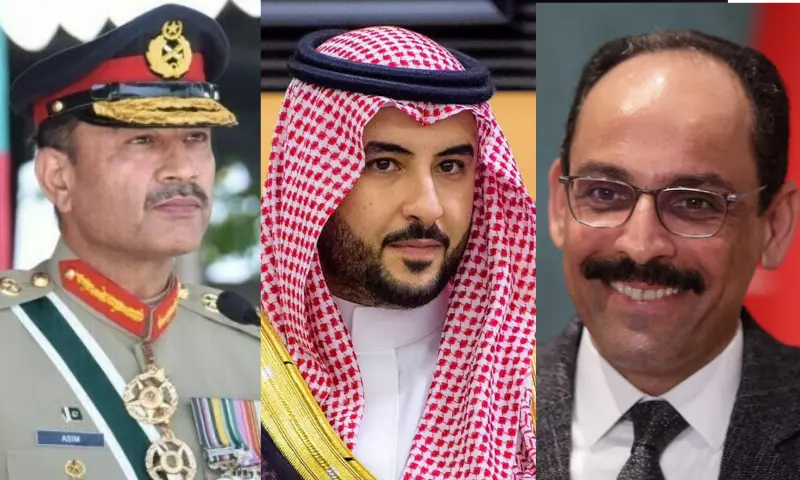
Senior officials from Pakistan, Saudi Arabia and Turkiye were due in Tehran on Monday for four-party security talks with Iran's top security official, Iranian state media reported, under a defence pact the three countries signed in August.
Ali Bagheri Kani, deputy secretary of Iran's Supreme National Security Council, told state television that the visiting dignitaries would include Saudi Defence Minister Prince Khalid bin Salman, Turkish intelligence chief Ibrahim Kalin and Pakistan's Field Marshal Asim Munir, who holds the posts of Chief of Defence Forces and Chief of Army Staff. Kani said the meeting would be held with Iran's security chief, Mohsen Rezaei, according to the IRNA news agency, which Dawn cited.
"This four-party meeting in Tehran could represent an important and effective step towards building lasting regional security, and we hope this initiative will contribute to establishing a stable region," Kani said, without elaborating. He described the visit as part of efforts to implement the idea of "endogenous security" in West Asia.
The reports differed on timing. Dawn and IRNA said the officials would travel on Monday; Geo News reported that the Iranian official had not specified when the meeting would take place, while citing Reuters, which said the talks were scheduled for Monday.
The three visiting countries are partners in the Makkah Joint Defence Agreement, signed on August 7 in Makkah, which stipulates that an armed attack on one member is an attack on all three. According to a text seen by Reuters, its first article says the parties shall use "all necessary means" to eliminate threats to one another's territorial integrity, sovereignty or internationally recognised borders.
The pact was signed amid a regional conflict that erupted in February, when the United States and Israel launched surprise strikes on Iran while Washington and Tehran were still negotiating over Iran's nuclear programme. An April ceasefire brokered by Pakistan ended the initial phase of intense bombardment, but the two sides have continued to contest the Strait of Hormuz, through which about a fifth of the world's oil and liquefied natural gas once travelled. Iran has claimed control of the strait and has regularly targeted vessels crossing without its authorisation, while the United States has imposed a naval counter-blockade on Iranian ports. Diplomacy with Washington has been stalled since a June deal setting out a path to a permanent settlement collapsed, and the fighting has spread to include clashes between Saudi Arabia and the Houthis in Yemen.
None of the reports carried a statement from Pakistan's Foreign Office or the Inter-Services Public Relations on the Tehran visit. Separately, Minute Mirror reported that ISPR Director General Lieutenant General Ahmed Sharif Chaudhry had told CNN that Pakistani troops have been stationed in Saudi Arabia for decades, serving in training, advisory and defensive roles.
Watch

Information ministry blames Kabul inaction for strained Pakistan-Afghanistan ties
The ministry rejected a Taliban spokesperson's account of the dispute, saying cross-border militancy remains the biggest obstacle to normal relations between the neighbours.

Tarar proposes national council on cyber security and digital literacy
The information minister used the PTA's Cyber Security Awareness Week to float a coordinating body and to call for digital literacy in school curricula.

Health minister says barcode scan will flag fake medicines from November
Mustafa Kamal told the National Assembly that hospitals will also have to buy all vaccines from Pakistan's own funds by 2030, at a cost of about $1.2 billion.

Fakhar Zaman hits century and passes 4,000 ODI runs
The Pakistan batter reached 4,000 one-day international runs in his 97th ODI and became the 16th from his country to pass the mark.