PM asks JI to delay petroleum levy march until return
Government has proposed suspending the levy for one year as the Jamaat-e-Islami train march reaches Multan, sources say.
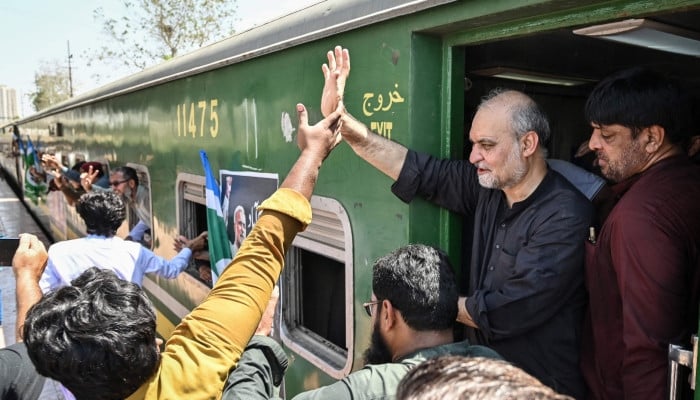
Jamaat-e-Islami's train march against the petroleum levy reached Multan late Monday night, and Prime Minister Shehbaz Sharif telephoned party emir Hafiz Naeemur Rehman on Tuesday asking him to postpone the protest until the prime minister returns to Pakistan, according to JI spokespersons cited by Geo News and other outlets.
The prime minister said he was ready to hold meaningful talks with the JI on the petroleum levy after his return, the spokespersons said. Hafiz Naeem replied that the party did not seek a law-and-order problem or a confrontation with the government, but that the government had to respect its right to protest. He said the JI would consult its Shura before responding to the request to delay the march.
ARY News reported, citing sources, that the government has proposed abolishing the petroleum levy for one year and presented what those sources called a major public relief package to the JI leadership, subject to approval by the party's technical committee. The report said a breakthrough was possible before the march reached Islamabad, and that a meeting between the prime minister and the JI leadership was expected after his return. It also said a member of the government delegation supported ending the levy.
The JI began its long march from Karachi on Sunday against the petroleum levy, fuel prices and inflation, according to Geo News. The caravan is to continue towards Lahore before the final phase towards Islamabad. Dawn reported that JI Khyber Pakhtunkhwa emir Abdul Wasey said on Monday that the party would march on Islamabad on September 23 and that it had decided not to hold further negotiations after five rounds of talks failed to produce results. Hafiz Naeem said the march had been delayed for four hours but supporters still turned out in Multan. He said people were also coming out in parts of Balochistan and Khyber Pakhtunkhwa. He reiterated the demand that the government withdraw what the party calls an unfair tax on petroleum products and provide relief to the public.
Addressing supporters at Multan railway station, Hafiz Naeem cited the prices of wheat, flour and sugar as examples of economic pressure on consumers. He alleged that flour and sugar mafias had influence within political parties and criticised what he described as inconsistent government policies on sugar imports and exports. He also referred to the JI's earlier campaign over agreements with independent power producers, saying the party had represented the public's interests in that matter as well.
ECP sets ward delimitation for Quetta and Kharian cantonment boards
Quetta moves from Class-II to Class-I and Kharian from Class-III to Class-II, with 10 wards fixed in Quetta and five in Kharian under notifications issued on 29 October.

Information ministry blames Kabul inaction for strained Pakistan-Afghanistan ties
The ministry rejected a Taliban spokesperson's account of the dispute, saying cross-border militancy remains the biggest obstacle to normal relations between the neighbours.

Tarar proposes national council on cyber security and digital literacy
The information minister used the PTA's Cyber Security Awareness Week to float a coordinating body and to call for digital literacy in school curricula.

Health minister says barcode scan will flag fake medicines from November
Mustafa Kamal told the National Assembly that hospitals will also have to buy all vaccines from Pakistan's own funds by 2030, at a cost of about $1.2 billion.