Regional peace depends on ending Afghan terror threat: Dar
The deputy prime minister told ECO foreign ministers in New York that Kabul must act against the TTP and BLA.
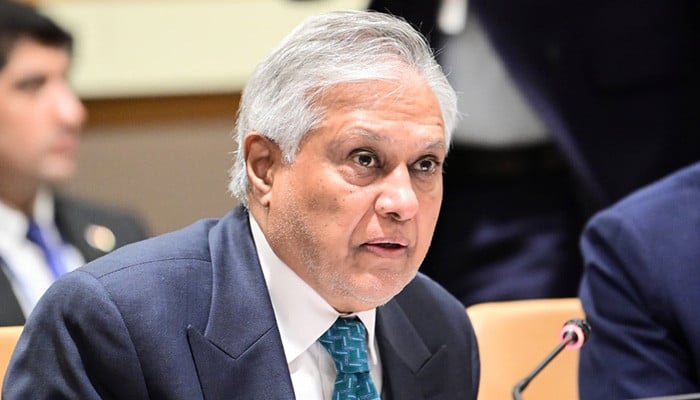
Deputy Prime Minister and Foreign Minister Ishaq Dar said in New York on Saturday that regional peace and development cannot be secured while terrorist groups continue to operate from Afghanistan. Addressing the 27th informal meeting of the Economic Cooperation Organisation Council of Ministers, he pressed the Taliban government to take concrete and verifiable action against militants who attack Pakistan.
The remarks were made on the sidelines of the 81st session of the United Nations General Assembly, against a backdrop of rising violence that Islamabad blames on Afghanistan-based fighters. Dar said Pakistan's only expectation from Kabul was that it address what he called legitimate security concerns, naming the banned Tehreek-e-Taliban Pakistan and Balochistan Liberation Army as groups that threaten Pakistan's sovereignty and citizens.
"Peace and development in the region can only be achieved with the elimination of the terrorist threat which is emanating right now from Afghanistan," he was quoted as saying by Geo News.
The deputy prime minister said Pakistan had pursued constructive engagement with the Taliban, offered bilateral and transit trade concessions, and made a framework agreement for a feasibility study of the Uzbekistan-Afghanistan-Pakistan railway project a priority. He described Pakistan's approach to Afghanistan as part of broader goals of peace, development and regional integration.
Dar, whose country is chairing the ECO Council of Ministers for 2026-27, said member states should harness their collective potential for nearly half a billion people. He listed Pakistan's chairmanship priorities: stronger intra-regional trade and economic integration, better connectivity and transit corridors linking Central Asia to Arabian Sea ports, a digitally enabled ECO Free Trade Area, and greater cooperation on climate resilience. He noted that ECO states account for about 2.2 percent of global trade, while trade among members represents roughly 8 percent of their overall regional trade.
The minister also expressed concern over the security situation in the Middle East and reaffirmed Pakistan's commitment to peaceful resolution of disputes under international law. He said Pakistan had continued diplomatic efforts to de-escalate the US-Iran conflict, facilitating dialogue and supporting the Islamabad Memorandum of Understanding.
The informal meeting brought together foreign ministers and senior representatives of ECO member states. It was used to build momentum ahead of the 30th ECO Council of Ministers meeting, scheduled for Islamabad in November, Geo News reported.

ECP sets ward delimitation for Quetta and Kharian cantonment boards
Quetta moves from Class-II to Class-I and Kharian from Class-III to Class-II, with 10 wards fixed in Quetta and five in Kharian under notifications issued on 29 October.

Information ministry blames Kabul inaction for strained Pakistan-Afghanistan ties
The ministry rejected a Taliban spokesperson's account of the dispute, saying cross-border militancy remains the biggest obstacle to normal relations between the neighbours.

Tarar proposes national council on cyber security and digital literacy
The information minister used the PTA's Cyber Security Awareness Week to float a coordinating body and to call for digital literacy in school curricula.

Health minister says barcode scan will flag fake medicines from November
Mustafa Kamal told the National Assembly that hospitals will also have to buy all vaccines from Pakistan's own funds by 2030, at a cost of about $1.2 billion.