Supreme Court body agrees e-filing pilot for family cases
The National Judicial Automation Committee will start the programme in selected courts across all provinces and Islamabad.
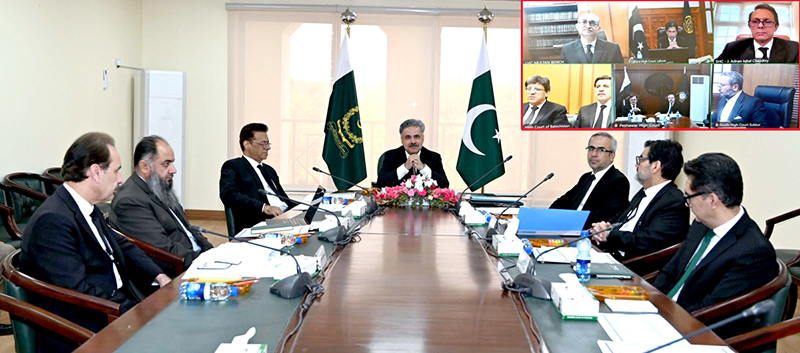
Chief Justice of Pakistan Yahya Afridi chaired a meeting of the National Judicial Automation Committee at the Supreme Court, where judges and officials agreed to begin work on an electronic filing pilot project for family cases.
The Associated Press of Pakistan reported that Justice Afridi, who chairs both the Supreme Court and the National Judicial Policymaking Committee, presided over the session. According to a statement issued after the meeting and carried by Minute Mirror, the committee agreed to launch the pilot in selected courts across all provinces and Islamabad. The pilot is the initial phase of the plan.
Participants discussed the introduction of a uniform electronic filing system for courts nationwide. They also considered a proposed “One Case, One Identity” mechanism under which every case would be given a unique identification number. The system is intended to make it easier to track cases and manage judicial records through a centralised digital mechanism. The mechanism would allow litigants, lawyers and judges to access case records through a centralised digital system.
A single comprehensive e-filing template for the whole country was also proposed during the meeting. The committee directed members to submit their recommendations on the proposed template within two weeks. It also stressed that the system should be simple and user-friendly so that judges, lawyers, court staff and litigants can use it without difficulty.
The meeting was attended in person by Justices Muhammad Ali Mazhar, Arbab Tahir and Azam Khan. Judges from the Lahore High Court, Sindh High Court, Peshawar High Court and Balochistan High Court joined through video link. Lahore High Court judges Justice Sultan Tanveer Ahmed and Justice Khalid Ishaq participated through video link, while Sindh High Court's Justice Muhammad Faisal Kamal Alam and Justice Adnan Iqbal Chaudhry joined online. Peshawar High Court was represented by Justice Waqar Ahmed and Justice Muhammad Fahim Wali. Balochistan High Court judges Justice Shaukat Ali Rakhshani and Justice Gul Hasan Tareen also attended virtually.
The committee reviewed a dashboard designed to provide real-time monitoring of judicial data. Members expressed concern over delays in receiving judicial data from prisons, noting that information from prisons is currently arriving with a delay of about one month, which can affect timely monitoring and coordination between judicial institutions.

ECP sets ward delimitation for Quetta and Kharian cantonment boards
Quetta moves from Class-II to Class-I and Kharian from Class-III to Class-II, with 10 wards fixed in Quetta and five in Kharian under notifications issued on 29 October.

Information ministry blames Kabul inaction for strained Pakistan-Afghanistan ties
The ministry rejected a Taliban spokesperson's account of the dispute, saying cross-border militancy remains the biggest obstacle to normal relations between the neighbours.

Tarar proposes national council on cyber security and digital literacy
The information minister used the PTA's Cyber Security Awareness Week to float a coordinating body and to call for digital literacy in school curricula.

Health minister says barcode scan will flag fake medicines from November
Mustafa Kamal told the National Assembly that hospitals will also have to buy all vaccines from Pakistan's own funds by 2030, at a cost of about $1.2 billion.