Federal Constitutional Court faults Supreme Court bench over decided case
Two-judge bench headed by Chief Justice Amin-ud-Khan dismissed the review petitions, holding that the Supreme Court's 28 December 2021 ruling on the Income Support Levy remains undisturbed.
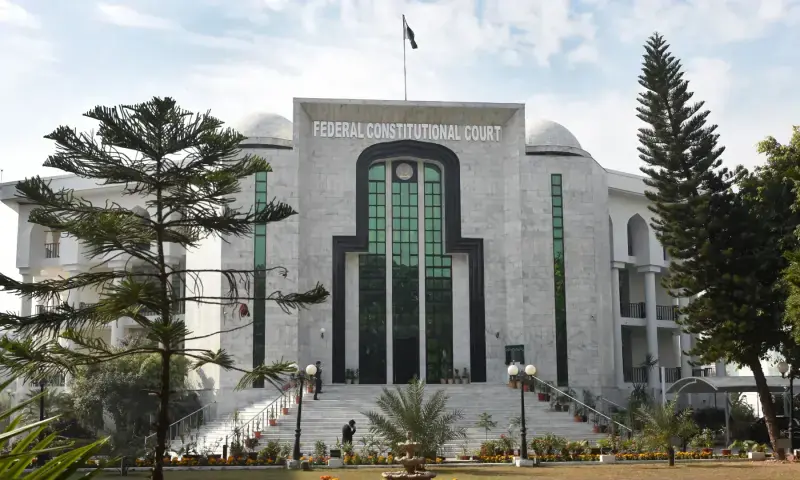
ISLAMABAD: The Federal Constitutional Court on Wednesday faulted a Supreme Court bench for the course it adopted in a matter it said had already been decided, and dismissed review petitions against the Supreme Court's December 2021 judgment on the Income Support Levy.
The two-judge FCC bench, headed by Chief Justice Amin-ud-Khan, held that the Supreme Court's judgment dated 28 December 2021 "shall remain undisturbed", according to The Nation's account of the ruling. The court observed that the course adopted in a subsequent order, authored by Justice Munib Akhtar, described by The Nation as the Supreme Court's senior puisne judge, raised "serious concerns regarding judicial discipline, legal norms and institutional propriety, particularly when the earlier determination remained operative and was already the subject of review proceedings". Dawn carried the same observation in its report.
The bench restated the scope of review jurisdiction, saying it is limited and exceptional and exists to correct an error apparent on the face of the record rather than to secure a fresh determination. Review is corrective rather than substitutive, it said, and cannot be widened by pointing to later proceedings involving similar questions of law.
According to The Nation, the judgment held that a determination validly rendered by a competent bench keeps its legal effect unless modified, recalled or set aside through a recognised procedure, and that the mere pendency of connected proceedings, or a subsequent grant of leave in another matter, does not by itself justify reconsidering an earlier judgment.
The court said coordinate or subsequent benches must accord due regard to earlier determinations, and that any departure must conform to established principles of precedent and the prescribed institutional procedure. "We reiterate that adherence to judicial discipline is indispensable to maintaining certainty, consistency and the institutional integrity of judicial adjudication," Chief Justice Amin was quoted as saying.
On the merits, the bench said the petitioners had not shown a patent misreading or non-reading of constitutional provisions, the omission of a material issue going to the root of the controversy, or any defect of a magnitude that would justify reopening the judgment. While the power of review exists to prevent manifest injustice, it cannot be used "merely to secure a different conclusion upon the same material".
The underlying dispute concerned the constitutional character of the Income Support Levy introduced through the Finance Act, 2013, and whether legislation imposing such a levy could validly be enacted as a Money Bill under Article 73(2). According to The Nation, the Supreme Court examined the definition of taxation in Article 260(1) and the legislative procedure set out in Articles 70 and 73, and concluded that the levy, despite its financial implications, did not fall within the Money Bill classification and had to pass through the ordinary procedure involving both Houses of Parliament.
The court noted that the levy's validity had already been examined by a two-member Supreme Court bench in Commissioner Inland Revenue v. Muhammad Mustafa Gigi and others (PLD 2022 SC 420).
ECP sets ward delimitation for Quetta and Kharian cantonment boards
Quetta moves from Class-II to Class-I and Kharian from Class-III to Class-II, with 10 wards fixed in Quetta and five in Kharian under notifications issued on 29 October.

Information ministry blames Kabul inaction for strained Pakistan-Afghanistan ties
The ministry rejected a Taliban spokesperson's account of the dispute, saying cross-border militancy remains the biggest obstacle to normal relations between the neighbours.

Tarar proposes national council on cyber security and digital literacy
The information minister used the PTA's Cyber Security Awareness Week to float a coordinating body and to call for digital literacy in school curricula.

Health minister says barcode scan will flag fake medicines from November
Mustafa Kamal told the National Assembly that hospitals will also have to buy all vaccines from Pakistan's own funds by 2030, at a cost of about $1.2 billion.