National CERT warns banks and utilities of AI-driven cyber attacks
The advisory names core banking networks, payment platforms and mobile apps as exposed, and lists power, water and oil and gas installations as high-value targets.

Pakistan's National Cyber Emergency Response Team has issued a security advisory warning that financial institutions and critical national infrastructure face growing artificial intelligence-driven attacks, and it told regulators and operators to put countermeasures in place without delay.
According to Daily Times, which reported the advisory, attackers are using AI tools, automated bots, botnets and agentic systems to speed up their operations and make them harder to detect. Core banking networks, digital payment platforms and customer mobile applications are named among the exposed systems.
National CERT singled out unauthorised manipulation of displayed account balances, warning that altered figures could produce public anxiety and financial instability. The advisory says national regulatory authorities have instructed all financial organisations to enforce security countermeasures immediately.
Beyond banking, it lists oil and gas installations, water management utilities, power generation plants and electricity distribution networks as primary high-value targets. Industrial manufacturing hubs and national transport management systems are also described as open to intrusion. Security analysts cited in the advisory said a successful breach of operational technology could disrupt essential public services and economic activity, and operators were told to audit network access protocols and isolate mission-critical management systems.
For defences, National CERT recommended strict monitoring of corporate network interfaces and customer-facing application programming interfaces. Security teams should track automated login attempts, repeated authentication failures, credential stuffing campaigns and abnormal API requests. The advisory asks for real-time alerts on unauthorised configuration changes and unusual transaction patterns, and continuous integrity checks on customer records and backend databases.
It cited recent incidents in Europe in which refrigeration and cooling systems at several major supermarket chains were compromised, causing commercial damage and stock losses. No formal investigation has confirmed AI involvement in those events, the advisory says, but it presents them as a warning of what digital breaches can do to physical operations.
Public and private entities were urged to assess their readiness against bot-driven attack methods and to adopt independent transaction verification that can detect altered banking requests or unauthorised transfers. The advisory also recommends redundant data backups and upgraded encryption across core communication channels.
A separate analysis published by TechJuice argued that security practice in most Pakistani institutions never caught up with digitisation, and that periodic audits and security purchases cannot replace continuous technical oversight and incident response capacity. It cited a cyberattack reported in June 2026 by the Capital Development Authority on its property and water billing system, which interrupted online services and whose technical cause has not been made public. The analysis also described the 29 October security incident at the cryptocurrency exchange Binance, where attackers used stolen credentials and compromised internal AI tooling to move about $6.34 billion in digital assets.
How the reports differ
Daily Times reported the advisory's contents directly: the systems it names, the risk it attaches to displayed account balances, and its list of monitoring steps. TechJuice did not carry the advisory's specifics, publishing instead an analysis arguing that Pakistani institutions' security practice never caught up with digitisation, and citing a June 2026 cyberattack on the Capital Development Authority's billing system and the October Binance breach. Daily Times framed the story as a warning to financial institutions; TechJuice framed the same subject around gaps in Pakistani security practice.

US agencies warn of cyber threat to industrial refrigeration
The FBI, CISA and three departments say hackers could change temperatures in cold storage, causing fires and spoiling inventory.

Pakistan and Russia push IT cooperation toward pilot projects
Companies from both countries were matched at a PSEB and Moscow University webinar in Islamabad, where the planning minister set out a $1 trillion economy target for 2035.

Pakistan renews call for Palestinian state after Istanbul meeting
Foreign Office spokesperson Sajjad Haider Khan said the Istanbul meeting also condemned Houthi attacks on Red Sea shipping and backed safe passage through the Strait of Hormuz.

Government appoints Mustafa Ramday PSO chairman for three years
The Supreme Court advocate and former Punjab advocate general says he will forgo directors' fees, travel and other costs attached to the job

PM approves restructuring of TDAP to push exports
Shehbaz Sharif ordered merit-based hiring and an outside audit firm after a review of the trade authority's performance in Islamabad.
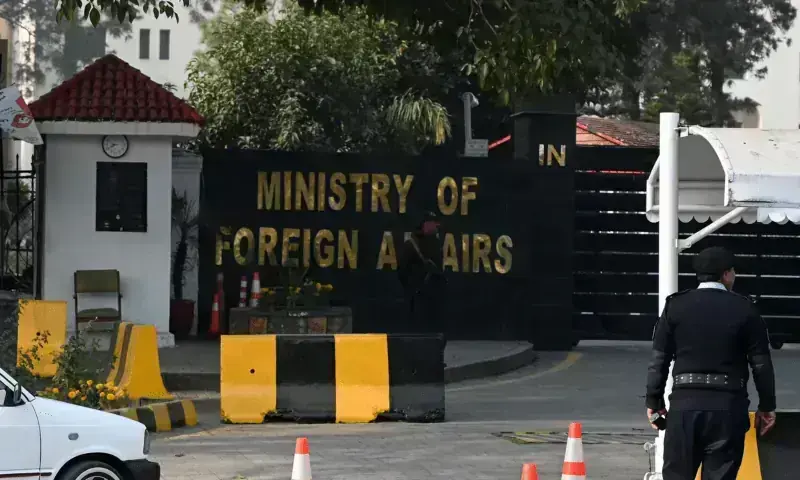
PAC tells foreign ministry to tighten accounting over mission fund abuse
The committee said staff in overseas missions were embezzling public money without accountability and ordered new secretary Asim Iftikhar Ahmad to send it revised rules.

Polio campaign reaches 22.1 million children in four days
The National Emergency Operations Centre says the fifth day of the 97-district round is under way and teams will keep working until November 8.

PTA and Meta block 176,000 WhatsApp accounts on recycled SIMs
The regulator has shared about 10 million recycled numbers with the platform and will send 5,000 a month to catch accounts left active after old SIMs were cancelled.