Pakistan pitches trade hub status at Baku investment forum
Federal Minister Abdul Aleem Khan told delegates that Karachi Port, Port Qasim and Gwadar Port remain operational and pitched Pakistan as a corridor to Central Asia and the South Caucasus.
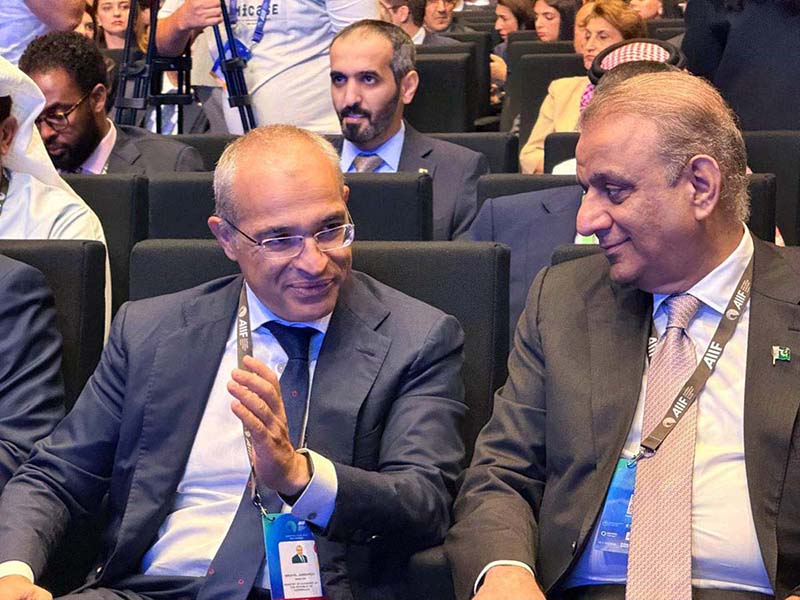
Federal Minister for Communications Abdul Aleem Khan presented Pakistan's approach to regional trade, infrastructure and economic stability at the second International Investment Forum in Baku, Azerbaijan, where he said the country's deep-sea ports remain fully operational to keep global supply chains moving during regional conflict.
Khan spoke on a high-level panel alongside Azerbaijan's Minister of Economy Mikayil Jabbarov and Turkey's Minister of Treasury and Finance Mehmet Şimşek, according to ARY News. The Associated Press of Pakistan published photographs of Khan and Jabbarov in conversation at the inaugural session. The panel also included ministers and senior economic officials from Uzbekistan, North Macedonia, Syria, Tajikistan and Montenegro, ARY reported.
The minister told delegates that petroleum and maritime freight inflation and geopolitical upheaval were disrupting established trade routes. He said Pakistan had imposed strict fiscal discipline and proactive national austerity measures to protect public finances and preserve economic resilience.
Khan said Pakistan was positioning itself as a neutral diplomatic venue and constructive mediator in regional conflicts to de-escalate tensions and ensure long-term trade continuity. He said the country was using its geoeconomic position to serve as a reliable transshipment hub and safe haven for regional commerce.
He said Karachi Port, Port Qasim and Gwadar Port were fully operational. Karachi Port Trust alone handled more than 54.68 million metric tons of cargo in the previous fiscal year, he stated. The minister described Pakistan as an ocean gateway for landlocked Central Asian Republics. Exports to Kazakhstan exceeded $240 million and exports to Uzbekistan surpassed $118 million, he said.
On infrastructure, Khan outlined the M-6 Motorway, M-10 and MNJC Motorway projects as trade arteries offering seamless connectivity to Western China and Central Asia. He highlighted bilateral trade arrangements with Azerbaijan supported by 1,500 annual reciprocal transport permits, which link Pakistani deep-sea ports directly to the South Caucasus and the Trans-Caspian Middle Corridor.
Khan also reaffirmed Pakistan's commitment to expanding public-private partnerships, paperless TIR customs digitalisation, and integrating the China-Pakistan Economic Corridor with the Economic Cooperation Organization, the Central Asia Regional Economic Cooperation programme and the Shanghai Cooperation Organisation to build a durable Eurasian economic bridge.
ECP sets ward delimitation for Quetta and Kharian cantonment boards
Quetta moves from Class-II to Class-I and Kharian from Class-III to Class-II, with 10 wards fixed in Quetta and five in Kharian under notifications issued on 29 October.

Information ministry blames Kabul inaction for strained Pakistan-Afghanistan ties
The ministry rejected a Taliban spokesperson's account of the dispute, saying cross-border militancy remains the biggest obstacle to normal relations between the neighbours.

Tarar proposes national council on cyber security and digital literacy
The information minister used the PTA's Cyber Security Awareness Week to float a coordinating body and to call for digital literacy in school curricula.

Health minister says barcode scan will flag fake medicines from November
Mustafa Kamal told the National Assembly that hospitals will also have to buy all vaccines from Pakistan's own funds by 2030, at a cost of about $1.2 billion.